
Maintenance
Why annual air conditioning maintenance matters
Discover how annual maintenance helps reduce energy use, extend service life and maintain air quality.
Maintenance
Learn which parts are cleaned and checked during professional air conditioning maintenance, and why these checks matter.
Briseon · 12 augustus 2026 · 3 min read
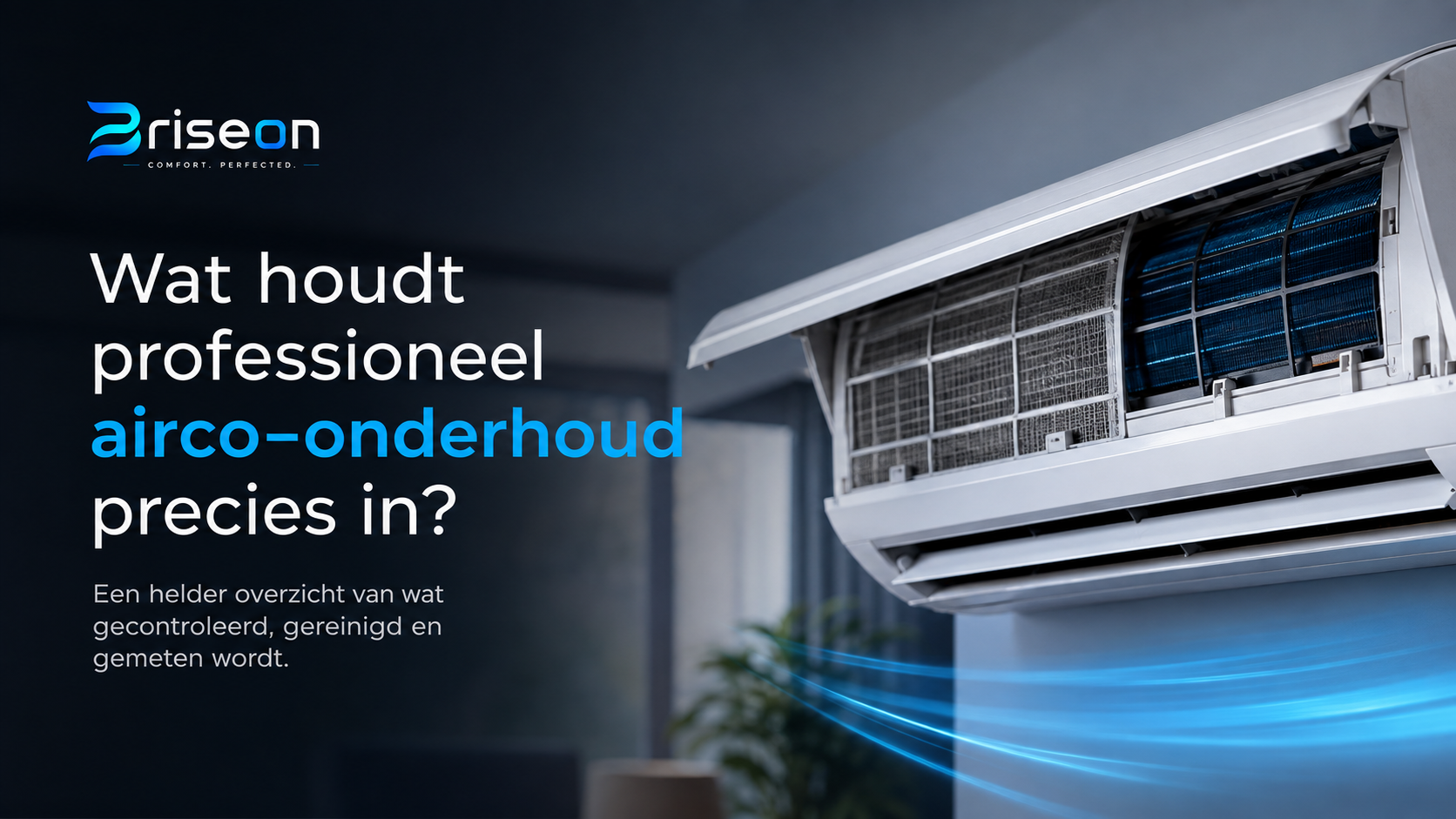
Air conditioning maintenance means more than a quick filter clean. A professional checks, cleans and tests several components to assess whether the system continues to work correctly.
A unit may still cool while airflow decreases, parts become dirty or small abnormalities develop. These can be early signs of future faults.
A service ideally starts with the system running. The technician checks indoor and outdoor units, error messages, noise or vibration, airflow and cooling or heating performance. This establishes the system’s condition before cleaning begins.
Filters collect particles before air passes through the heat exchanger. Over time, dirt can restrict airflow and make the system work harder. Filters are removed, inspected and cleaned. Damaged or badly worn filters may need replacement.
Behind the filters, air circulation and condensation can lead to deposits on the heat exchanger, fan, air guides, condensate tray and casing.
Cleaning depth depends on dirt levels and use. A unit running daily in a commercial setting may need different care from one used at home for only a few months each year.
Cooling produces water inside the indoor unit. A tray and drain pipe carry it away. Dirty or blocked drainage can cause leaks, odours or damp. The drain is checked and cleaned or flushed where necessary.
Dust, leaves, pollen, fluff, insects and surrounding dirt can build up on the outdoor heat exchanger and reduce heat transfer. The technician checks the exchanger, fan, casing and visible connections, cleaning as required.
Checks include damaged insulation, corrosion, damaged pipework, oily traces around connections, unusual ice and other visible abnormalities.
Opening the refrigeration circuit or measuring refrigerant pressure is not necessary at every standard service. If there are signs of incorrect operation, further technical investigation may be needed.
Depending on system type and access, connections and wiring can be visually checked for wear, discolouration or loose connections. Additional electrical measurements are taken where there is reason to do so.
Measuring the air entering and leaving the indoor unit gives a temperature difference commonly called Delta T (ΔT). This helps assess performance.
It must always be considered alongside indoor temperature, humidity, fan speed and room load. It is a useful check, not a complete diagnosis on its own.
After reassembly, the technician checks startup, fan operation, air flap movement, unusual noises, cooling or heating and any visible problems. This verifies operation following the service.
A service should provide more than a simple “everything is fine”. A report records the work and findings. Depending on the system, it may include:
It also creates a useful history for future visits.
Usage, surroundings, dirt levels, age, equipment type, previous faults and general condition determine maintenance needs. Professional servicing does not mean automatically carrying out identical tasks on every unit. The technician assesses what is actually needed.
For many residential systems, a periodic check, often around once a year, is a practical guide. Intensive or commercial use may require more frequent visits. Frequency depends on the equipment, operating hours and environment. Our article on annual maintenance covers this in more detail.
With many systems, users can regularly check and clean filters following the manufacturer’s instructions. Professional maintenance goes further, assessing other components and overall operation. Basic care and periodic professional checks complement each other.
Briseon focuses on thorough maintenance, technical checks and clear reporting. Depending on the installation, filters, units, drainage, pipework and electrical components are inspected. Measurements are taken when they help assess operation.
You know what has been done and gain a clearer picture of your system’s condition. To have your air conditioning checked or serviced, start your enquiry at Briseon.be.
Comfort. Perfected.
Tell us what you need and we’ll assess the options for your home or business.
Maintenance
Discover how annual maintenance helps reduce energy use, extend service life and maintain air quality.